







































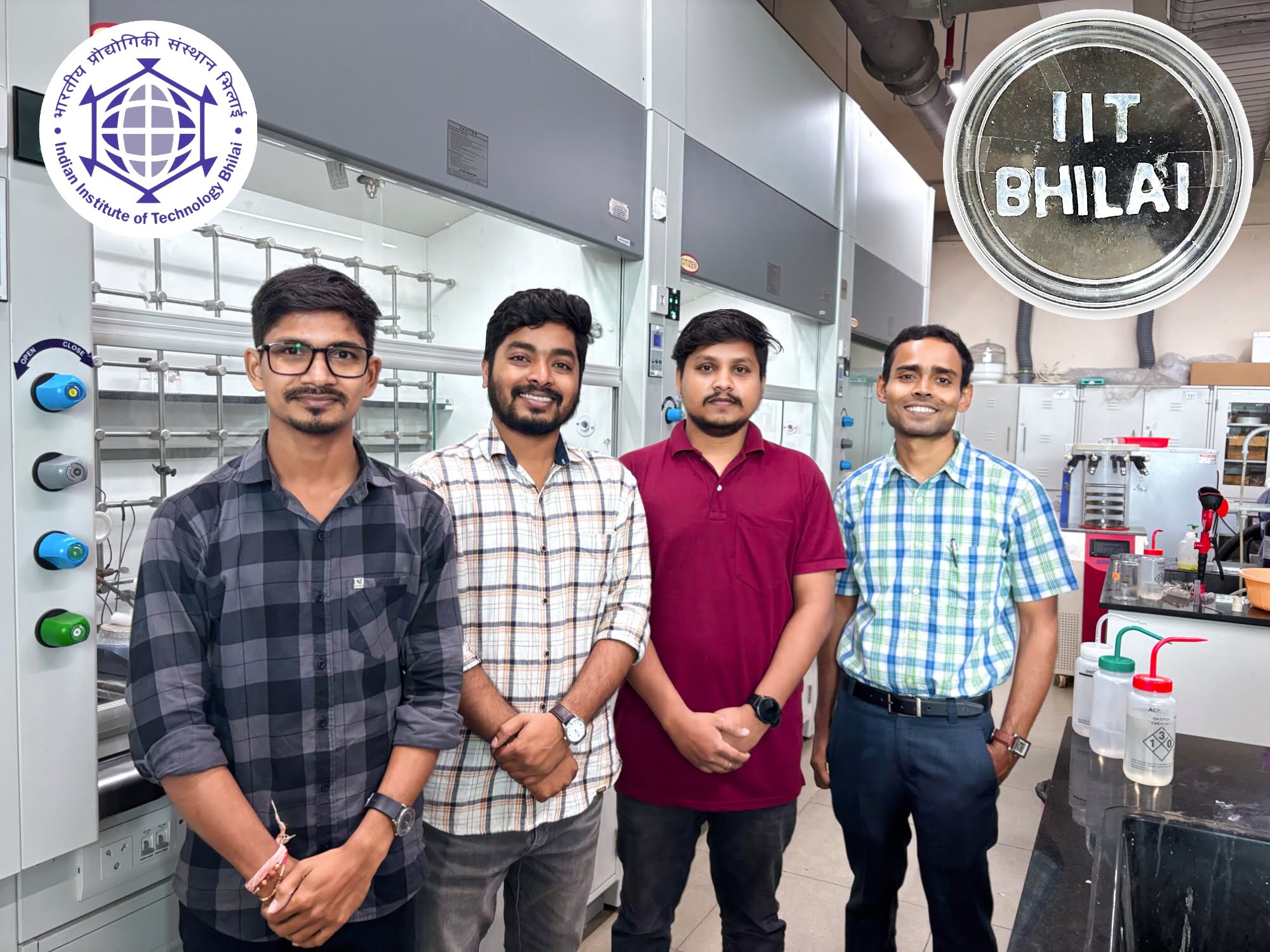






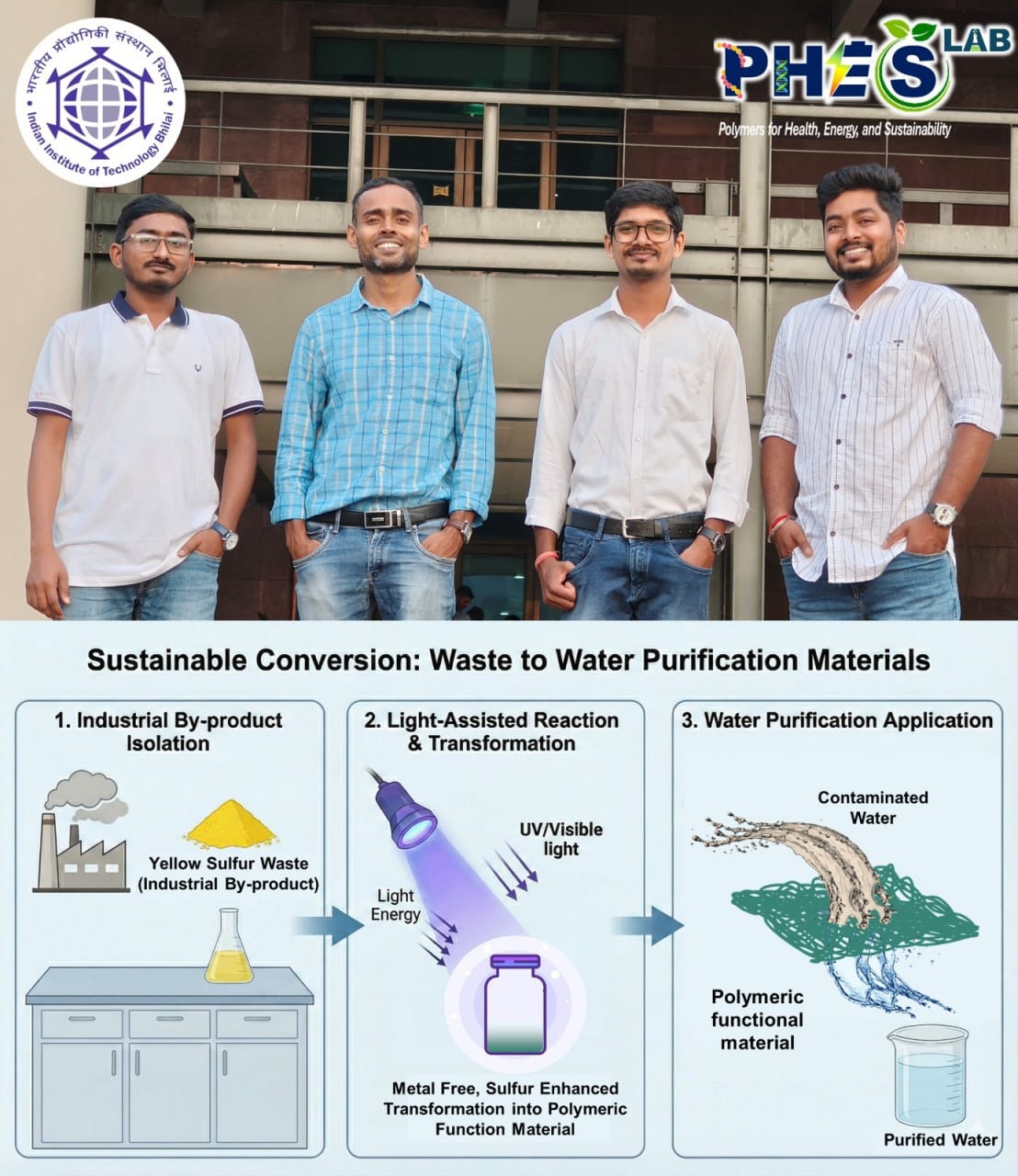
Linking sustainable chemistry to India’s national need for clean drinking water, scientists at IIT Bhilai have developed a polymer technology that uses industrial sulfur waste to combat water pollution. The research team, Bhanendra Sahu, Sudipta Pal, Priyank Sinha, and Dr. Sanjib Banerjee, developed a metal-free, environmentally friendly polymerization process that converts low-value sulfur waste into sulfur-dots (S-dots).
These S-dots act as green photocatalysts in the fabrication of advanced smart polymers. This work is published in the International Edition of Applied Chemistry. This innovation provides solutions to two major societal challenges: the management of industrial sulfur waste and the removal of harmful hydrophobic pollutants from polluted water. Sulfur waste from petroleum refining, coal processing, and chemical industries often poses disposal and environmental problems.
By converting this waste into high-value S-dots, the IIT Bhilai team has been able to create multi-arm star polymers that have excellent water purification capabilities. These star polymers spontaneously form nanoscale spherical structures that act like microscopic sponges, trapping hydrophobic pollutants. In tests, they successfully removed over 80 percent of harmful pollutants such as dyes, pesticides, and oil residues, demonstrating their strong potential for cleaning rivers and lakes. With water pollution in India rapidly increasing, especially in the industrial and agricultural sectors, this technology could strengthen wastewater treatment and environmental restoration efforts.

Highlighting this dual benefit, Dr. Banerjee said, “We first convert industrial waste into clean catalysts and then use them to create smart polymers that purify polluted water. This is a completely circular solution. This technology is aligned with national objectives such as the Jal Jeevan Mission, environmental restoration programs, and sustainable industrial practices. This metal-free, waste-based polymer technology, operating under mild UVA light, can prove to be a powerful tool in achieving India’s goal of safe, clean, and accessible water for all.”