






































































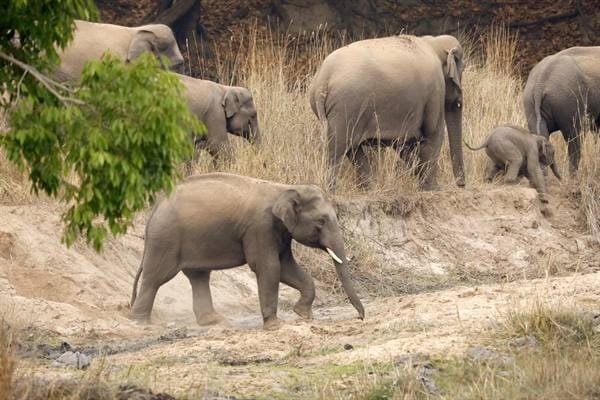
- 50 to 70 elephants are present in the Bandhavgarh Tiger Reserve, a favorite abode of the Gajrajs.
The presence of elephants in the forests of Madhya Pradesh is steadily increasing. Bandhavgarh Tiger Reserve, famous in the country and the world for tigers, is now emerging as a suitable habitat for elephants as well. Here the family of elephants is constantly flourishing. Around 50 to 70 wild elephants are currently estimated to exist in the Bandhavgarh Tiger Reserve and surrounding landscape. At the same time, a herd of about 25 elephants has been living continuously in the western Beuhari area of Shahdol district for the last one and a half years.
- Regular presence in Bandhavgarh since 2018
Area Director Bandhavgarh Tiger Reserve Shri Anupam Sahai said that the regular presence of elephants in Bandhavgarh Tiger Reserve was clearly recorded in October-2018. The elephants reached here through Bandhavgarh Landscape Corridor from Sanjay Gandhi Tiger Reserve. After this gradually the number of elephants and their range has expanded.
The migration of elephants is mainly seen in Khetauli, Panpatha Kor, Tala and Kallawah areas. Elephants are not permanently confined to any one area, rather they move to different areas according to their food, water and other needs. This is the reason why it is difficult to determine the permanent number of elephants in a range and they have to be regularly monitored.

- Food-water and safe environment become attraction
Bandhavgarh’s extensive natural and protected forest landscape provides favorable conditions for elephants. Adequate food and water, grasslands, bamboo areas, sal and mixed forests and other natural vegetation are available here in different seasons. Due to the safe environment and relatively less human interference, elephants find a favorable habitat here.
The increasing presence of elephants has also added new attraction to wildlife tourism in Bandhavgarh. Herds of elephants roaming freely in the forest, their accompanying children and their natural social interactions are becoming an exciting experience for tourists.
- Monitoring by technology and scientific method
Techniques, scientific studies, community partnerships and regular monitoring have been adopted by management to protect elephants and strengthen human-elephant coexistence in Bandhavgarh. A special Gajrakshak app is being used for information about the location, movement and alerts of elephants.
Hathi Mitra Dal has been formed to partner local communities. Apart from this, the activities and range of elephants are being studied through radio-collaring and scientific monitoring. Elephants are identified on the basis of their ear shape, spots, tusks, tail and other distinctive features of the body and each elephant is given a unique identification number.
Monitoring through the Elephant Control Room has been arranged for prompt exchange and action of elephant-related alerts. Information related to elephant management is being imparted to the frontline staff through periodic training and workshops. Efforts are being made to adapt the experiences of elephant management and human-elephant conflict reduction to local conditions in other states, especially in West Bengal.
- A herd of 25 elephants in Beuhari area
According to Smt. Taruna Verma, DFO of Shahdol North Forest, the movement of elephants in the Shahdol area has been historic. In recent years around the year 2005 elephants have been recorded coming and going in the Shahdol region. In the year 2018, a herd of elephants came here and later stayed permanently in the Bandhavgarh Tiger Reserve area.
At present, a herd of about 25 elephants is living in the western Beuhari region of Shahdol North Forest for the last one and a half years. This area is providing favorable conditions for elephants. In the Bansagar backwaters, adequate water, relatively few human settlements and sufficient food available in the bamboo forests with less human interference provide a safe and favorable environment for elephants.
- Madhya Pradesh became the permanent home of elephants after about 100 years
According to the Status of Elephant in India report for the year 2021-25, the total number of wild elephants in Madhya Pradesh is recorded at 97. The report is based on the country’s first DNA-based elephant census, released by the Wildlife Institute of India (WII) and Project Elephant.
Historically, the region of Madhya Pradesh has been an important habitat for elephants. In the 16th-17th century, there is a large population of elephants. Later, due to poaching, deforestation and increasing human interference, the number of elephants in Madhya Pradesh was reduced to zero by 1925. After almost a century, elephants have arrived in Madhya Pradesh from Chhattisgarh, Odisha and Jharkhand and are making their home in the favorable forest areas here.
Currently Bandhavgarh Tiger Reserve, Sanjay-Dubri Tiger Reserve and Bansagar backwater areas of Shahdol are emerging as preferred habitats for elephants.
- Emphasis on human-wildlife co-existence with elephant conservation
Protection of elephants is not limited to the protection of only one species, rather it is a matter related to the protection of the entire forest, its ecosystem and human-wildlife co-existence. Efforts are being made in Bandhavgarh to ensure that the elephants remain safe in the forest and the local community also moves forward maintaining a safe co-existence with them.
The total number of wild elephants in India is reported to be 22 thousand 486. State-wise, Karnataka has the highest number of elephants, followed by Assam, Tamil Nadu, Kerala, Uttarakhand and Odisha. The growing number of elephants and human-elephant co-existence in Madhya Pradesh is also being seen as an important achievement in the direction of wildlife conservation.